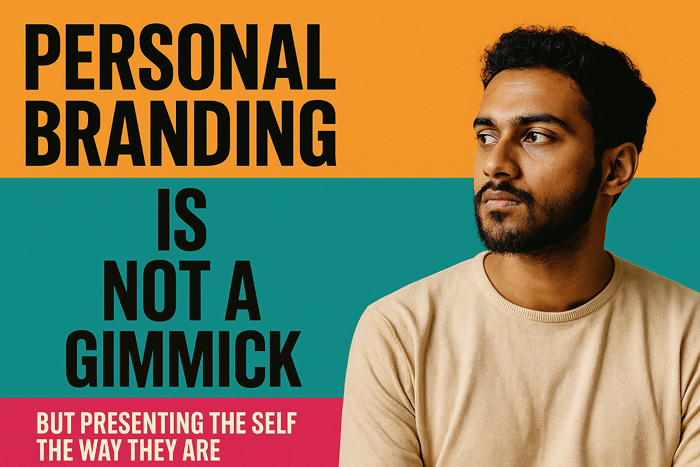
In a world drowning in images, filters, and followers, many purist creators—most of them, artists, writers, and thinkers—would probably give the phrase ‘personal brand’ a dirty look. It feels performative, transactionary, and even insulting. On the other hand, professionals regard branding as a tool—not of manipulation but of clarity and connection. What fate awaits these two worlds when they bump into one another?
I once had one of those deep conversations with a classicially trained artist, one of those who has spent many a decade in his workshop, practicing his craft in relative solitude, never asking for attention, always directed by integrity. The artist asked, “Why must I package myself to be heard? Is it not self-promotion that corrupts purity?”
His concern is not uncommon. The notion that authenticity and visibility are mutually exclusive is at the core of many creators’ belief system. It is a belief rooted in a romantic, and often dated, hypothesis of the artist as one detached from this world, the-worth-of-whom-lies-in-being-discovered-not-being-presented.
Now, the paradox: In this age of infinite content and attention spans so fragmented, not being seen is the equivalent of being non-existent. And that’s no judgment. You could indeed be making beautiful, heartfelt, and soul-stirring works for anybody to see, but if no one knows it exists, if no one can find you, the effects remain local.
“But shouldn’t the work speak for itself?” he argued. “Shouldn’t the message be more important than the messenger?”
Yes, indeed. But still, the messenger matters. Personal branding, an ethical process, was never about inflating a person’s importance. And it continues to present a context. It takes away the friction that exists between an artist and its audience—not so the artist can get famous, but so the artist can resonate.
There is a difference between self-promotion and self-expression. The former seeks validation. The latter seeks connection.
The aforementioned artist who refuses being in the spotlight might, however, relinquish center stage to less principled, more visible ones. Depth asks for that microphone in this loud world—not to dominate but so that they aren’t drowned.)
The most successful personal brand has never distorted who you are. Instead, it brings clarity. So when a person goes about encountering your name, face, or voice, they are not interacting with a contrivance—they are interfacing with you coherently and consistently.
Ethical personal branding is not a mask. It is a mirror. And if done right, it reflects who you already are—your values, your style, your truth. Not to manufacture perception, but to align it.
“Doesn’t that still make the person the product?” he asked.
Not exactly. No more do people connect with products. They connect with people. With purpose. With presence. A creator is not selling themselves when they build a brand—they are curating access to their worldview. That’s not commodification. That’s communication.
So really, personal branding is not a betrayal of artistic or intellectual integrity. It is a kind of bridge. A consciencious choice of appearing in the world so that one’s work, one’s worldview, can do what it was meant to: move people, challenge them, heal them, or simply make them pause.
The ethical dilemma is not being visible; it lies in how we choose to be seen. If we are grounded in truth, guided by purpose, and clear about our value-system, then personal branding becomes not a gimmick but a responsibility.