Ads in ChatGPT Free and Go versions are fair, even if the initial reaction to their announcement was largely negative. For years, users have been conditioned to see advertisements as intrusive interruptions, privacy risks, or signals of declining quality. That discomfort is understandable. Yet, stepping away from instinctive resistance reveals a basic truth often ignored in such debates: OpenAI is not a charitable institution. It is a business running one of the most advanced artificial intelligence systems ever built. The infrastructure required to operate ChatGPT—global servers, enormous power consumption, elite engineers, researchers, safety systems, and continuous upgrades—comes with substantial and recurring costs. These costs exist whether a user pays or not. Millions of people rely on ChatGPT daily without spending a rupee or a dollar. That raises a simple but unavoidable question: who funds this access? If users are not paying directly, the money must come from somewhere. In this context, advertising is not exploitation or corporate greed; it is a practical mechanism to keep the service available. Judged through this lens, ads become less an annoyance and more a logical consequence of scale and accessibility.
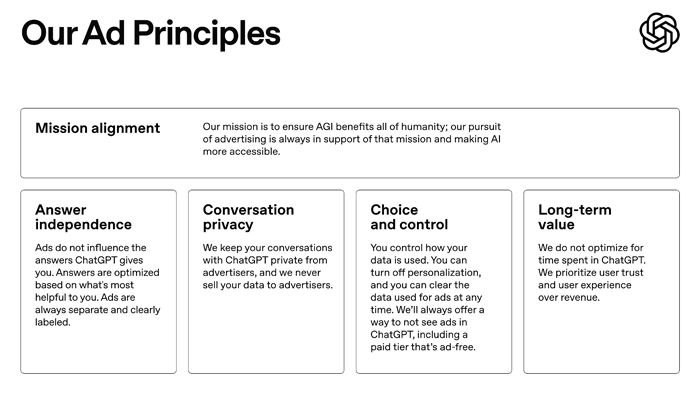
Critics often argue, “I don’t want ads,” which is a fair emotional response—but an incomplete economic argument. Ads in ChatGPT Free and Go versions are fair precisely because “free to use” does not mean “free to operate.” Servers do not function on goodwill, AI models are not trained on intention, and digital infrastructure does not sustain itself through idealism. Every prompt, response, and computation has a real financial cost attached to it. From a fairness standpoint, an ad-supported free tier is a reasonable exchange that allows broader access while distributing operational costs more equitably. It also prevents exclusion. Many users—students, early-stage founders, researchers, or individuals in lower-income regions—may not be able to afford subscription fees but still benefit immensely from AI tools. Advertising enables that access without forcing payment as a barrier. Importantly, OpenAI has clearly drawn a boundary: ads will not influence answers, shape opinions, or alter responses. They exist alongside the product, not inside its logic. The choice offered to users is transparent and longstanding—accept ads and continue for free, or pay for an ad-free experience. Expecting unlimited access with neither ads nor payment is not principled resistance; it is an unrealistic expectation.
What further strengthens the argument that Ads in ChatGPT Free and Go versions are fair is how deliberately OpenAI appears to be handling monetization. Unlike many platforms where advertising blurs into content or manipulates user behavior, OpenAI emphasizes separation and clarity. Ads are visibly marked, kept distinct from AI responses, and designed not to interfere with conversations. Privacy protections remain intact, users retain control over personalization, and higher-tier plans—Pro, Business, and Enterprise—are entirely ad-free. This is not a strategy to push ads indiscriminately, but to offer structured, respectful options. In an online ecosystem where trust is frequently sacrificed for revenue, this approach stands out. Leadership has also distinguished between useful, relevant ads and intrusive, low-value ones, signaling restraint rather than excess. Of course, execution will ultimately determine whether these principles hold. But intent matters, and the framework is sound. It is normal to dislike ads—most people do. Yet fairness requires acknowledging reality: if you are using a powerful product for free, someone else is paying for it. The equitable solution is simple and honest—either tolerate ads and continue using the service at no cost, or pay for a premium plan and enjoy an uninterrupted experience. Viewed this way, OpenAI’s decision is not harsh or exploitative; it is pragmatic, transparent, and arguably one of the more respectful monetization models in today’s digital economy.